
Breaking into Forward Deployed Engineering
EnrollA Forward Deployed Engineer works inside a customer's environment rather than in their own company's codebase. You find out what the customer actually needs, scope the work, write the integration code, deploy it on infrastructure you do not control, prove with numbers that it worked, and take what you learned back to your own product team. AI companies are hiring for this role faster than for any other.
The course covers three things, in this order.
The first is the engineering. You build retrieval systems, agents, voice interfaces and full-stack AI products, then deploy them on hosted models and on open-weight models you run yourself. Every build ships with an evaluation set, guardrails and tracing, because a customer will not accept a system they cannot measure.
The second is the customer work. You run discovery calls, scope and price an engagement, take a deployment through a security and procurement review, handle an incident without admin access, and hand the system over so it keeps running after you leave.
The third is the hiring process. You learn which interview rounds FDE loops draw from, how seven named companies run their loops, and how the loop changes by seniority and by type of employer. You then practise each round with timed mocks and recorded reps that are scored against a rubric.
How does this prepare you for an FDE interview?
- Run a discovery call that separates what the customer asked for from the problem they need solved.
- Scope and price an engagement, then write the integration code against systems you do not own.
- Build retrieval and agents that meet a customer's limits on latency, cost and network access.
- Deploy on the customer's own hardware when their data is not allowed to leave their network.
- Prove the work with evaluation sets, and get it through an enterprise security and procurement review.
- Resolve an incident in an environment where you have no admin access.
- Hold a safety boundary when a customer pushes for a feature that would break their own data governance.
- Practise every round of the FDE loop, including the case-study round, a timed system design and the offer negotiation.
Modules
Measure where you stand
- Score yourself against the FDE skill set and find the specific gap between your current role and the role you want.
- Decide which parts of the course to go deep on and which to review quickly.
Refresh the engineering foundations
- Work fluently at the command line, because you deploy into environments that have no graphical tools.
- Use Git, package managers and environment managers without looking anything up.
- Build a REST service in Python with FastAPI, backed by a SQL database.
- Read logs and debug a running service.
- Build a working demo interface in React or Streamlit that you can put in front of a customer.
Choose your lane, and decide whether it is FDE
- Compare the actual day-to-day work of an AI engineer, an AI product manager, a machine learning engineer, a solutions engineer, a sales engineer and an FDE, rather than their job titles.
- Match your background to a lane, including the case for not choosing this one.
- Measure success as the return on investment the customer gets, not the number of sprints completed.
- Trace the role from its origins at Palantir to the current hiring wave at AI companies, and understand why demand is rising now.
- Understand what you own in the role: the engineering, the consulting and the technical decisions a customer's CTO would otherwise make.
- Understand the cycle an FDE runs repeatedly: build the system, deploy it, then get the customer's team to adopt it.
Discover, scope and price an engagement
- Watch the customer's users do the work before writing any code, so you see the real workflow rather than the description of it.
- Run a discovery call that separates the stated request from the underlying problem.
- Scope the smallest deployment that delivers value, and keep scoping as the engagement changes.
- Recognise deployments that are likely to fail, and raise the risk before you write code.
- Write a one-page scope document: what the system does, what it does not do, what access you need, and how both sides will know it worked.
- Turn the customer's business rules into a technical specification and a sequenced plan. Ship a rough working version first, then harden it.
- Trade off scope against speed against quality, and say which one you gave up.
- Price the engagement as fixed scope, time and materials, or value-based, and understand how each model changes your incentives.
- Write and defend a statement of work.
Build the integration stack
- Connect systems with Python and TypeScript, APIs, webhooks, SQL and ETL jobs.
- Process customer datasets that are too large for one machine with Spark, so data preparation does not stall on a laptop-sized tool.
- Build a first integration against a mock environment that has missing fields, inconsistent formats and undocumented endpoints.
- Add logging and make operations idempotent, so a retried request does not repeat a side effect.
- Track cost from the first day with prompt caching, model routing and token budgets.
Build a full-stack AI product
- Connect a React frontend, a Node.js or FastAPI backend and an AI backend as one product, with shared state, streaming responses and error handling across all three layers.
- Trace a single request from the browser to the model and back, so you can debug a failure at any layer.
- Store conversation history and application state in MongoDB, and decide when a relational database such as PostgreSQL is the better fit.
- Deploy the frontend to Vercel and the backend as a container, so a reviewer can use the product from a link.
Work with LLMs directly
- Run the agent loop by hand: the model reasons, calls a tool, reads the result, and decides the next step.
- Write system prompts and enforce structured outputs, so downstream code receives data in the shape it expects.
- Engineer the context the model sees, and design the harness around it.
- Prototype a prompt and its tool definitions in the Anthropic Console Playground, then move the version that works into code.
- Call the Claude Messages API directly with tool use, then rebuild the same agent with an agent SDK: the Claude Agent SDK, the OpenAI Agents SDK, or LangGraph.
- Build the same agent with LangChain, and know which parts the framework handles for you and which parts you still have to write.
- Define tool inputs and model outputs as Pydantic models, so malformed data is rejected where it enters the application rather than failing further in.
- Decide between a managed agent service and a self-hosted agent, based on the customer's data rules and operating budget.
- Diagnose why prompt caching is not taking effect, and measure what long contexts cost in accuracy and money.
Choose the agent architecture deliberately
- Choose between tools, skills, subagents, MCP servers and Code Mode, and defend the choice.
- Design tool schemas the model can call correctly.
- Build multi-agent systems with orchestrator, planner and executor roles, and add points where a human must approve before the agent continues.
- Connect agents to each other and to outside systems with MCP and A2A.
- Contain failures, so one agent's error does not spread through the whole workflow.
- Give long-running agents semantic, procedural and episodic memory.
- Use spec-driven development and loop patterns that hold up across a deployment that runs for several weeks.
Build voice agents
- Compare a cascaded pipeline (speech to text, then the model, then text to speech) against a speech-to-speech model on latency, cost and control.
- Transcribe speech with Whisper, or with faster-whisper when latency matters, and measure transcription errors before they reach the model.
- Build an open-source voice agent and deploy it.
Look after the customer's data and run your own models
- Understand why open-weight models are a practical answer to a customer's data rules, not a position on open source.
- Run Llama-class and Qwen-class models with vLLM or Ollama, sized to the hardware the customer has.
- Host an open-weight model with vLLM on RunPod GPUs, or route requests through OpenRouter, so you can change model or provider without rewriting the application.
- Generate synthetic data, so you can prototype and backtest before you are cleared to see the customer's real data.
- Fine-tune with LoRA or QLoRA when the domain requires it, replace a closed model with the result, and use evaluations to decide whether the fine-tune was worth the cost.
- Run the fine-tune on the Hugging Face stack: Transformers to load the model, PEFT to attach the adapter, TRL's SFTTrainer to train it, and BitsAndBytes to quantise the base model to 4 bits so it fits on one GPU.
- Publish the trained adapter to the Hugging Face Hub, and benchmark it against the base model on the same evaluation set.
- Handle voice and image input for customers whose workflow does not start with a text box.
Build retrieval you can defend
- Learn what classic RAG, GraphRAG, agentic search and multimodal retrieval are each suited to.
- Choose between them with a rubric based on corpus shape, data freshness, query pattern and cost per answer.
- Chunk documents, generate embeddings, and combine keyword and vector search with rank fusion.
- Store embeddings in FAISS or Chroma for local work, in Pinecone as a managed service, or in pgvector when the customer already runs PostgreSQL. Choose between them on scale, cost and who has to operate the store.
- Build the same retrieval pipeline with LangChain and with LlamaIndex, and compare how much of the indexing and querying each framework does for you.
- Add semantic caching so that repeated questions do not pay for retrieval and generation twice.
- Add a knowledge graph when answers depend on relationships between entities.
- Search inside audio and video, and return the moment that answers the question rather than the whole file.
- Scale a retrieval pipeline to millions of documents while keeping latency and cost within the customer's limits.
- Measure retrieval quality directly, and detect the retrieval drift that tends to appear months after launch.
Use evaluations as the shared language with the customer
- Start an evaluation set at the prototype stage and grow it as the deployment grows.
- Evaluate an agent on its trajectory, meaning the steps it took, and separately on its outcome, meaning the final result.
- Build LLM-as-judge evaluators and custom metrics such as faithfulness and relevance, and check that the judge agrees with human raters.
- Backtest against user feedback, and test agents by simulating users.
- Add evaluation gates to CI, so that a regression fails the build and does not reach the customer.
- Track experiments, model versions and evaluation runs in MLflow, so you can show which change moved which score.
- Tie each evaluation to a business metric the customer tracks, so you can present the results to their finance team as evidence of value.
Defend against adversaries and add guardrails
- Add guardrails in stages from prototype to production. An instruction in the prompt is not a control, because an attacker can write prompts too.
- Explain the difference between direct and indirect prompt injection, and which one matters more in an enterprise deployment.
- Build a prompt-injection attack against your own application, improve it, then close the vulnerability.
- Treat retrieved documents and tool descriptions as untrusted input, because anyone who can write to the document store can plant instructions.
- Limit what an agent can do in code, not in the prompt, when it can issue refunds, update records or call production systems.
- Add model-based safety classifiers such as Llama Guard, and write explicit policy rules for what the system may and may not do.
- Validate model output with Guardrails AI, starting with pattern checks and adding semantic checks as the risk of a wrong answer rises.
- Understand Constitutional AI, Anthropic's method of training a model against a written set of principles, and what it does and does not guarantee about a system you deploy on that model.
- Redact personal data at all four points where it enters the system: user input, retrieved context, tool results and model output.
- Red-team a customer's system before go-live, and state the finding that would make you block the launch.
- Answer a customer who asks whether you train on their data, and explain what zero data retention does and does not change.
Deploy in someone else's environment
- Use Docker, Kubernetes, Terraform, CI/CD and cloud primitives on AWS, GCP and Azure, which are the tools customers will hand you.
- Use managed AI services: AWS Bedrock, Azure AI Foundry and Google Vertex AI.
- Package the whole system with Docker Compose, so a reviewer or a customer can start every service with one command.
- Split a product into services (application, inference, retrieval and background workers) that scale independently, and connect them with message queues.
- Set up SSO and SAML, authentication, secrets management, data boundaries and isolation between tenants.
- Integrate with legacy systems that are older than the customer's current technical leadership.
- Add tracing and dashboards that report latency, cost and quality for every request.
- Set alerts and spending limits, so a usage spike does not produce a bill the customer did not budget for.
Pass the customer's security and compliance review
- Work with SOC 2, HIPAA, GDPR and FedRAMP requirements at the level an FDE needs to answer a reviewer.
- Design data handling for a customer whose data must stay in the EU, and prove it in an audit.
- Scope an agent's access to the customer's systems and keep an audit trail of every action it takes.
- Keep a security review moving when it blocks go-live a week before launch, without cutting a corner you will regret.
Work on two fronts: the customer and your own product team
- Turn edge cases from the field into evidence for the product roadmap.
- Decide whether a request needs a one-off fix or a product feature, so you protect the platform while unblocking the customer.
- Package work you built for one customer into a reusable tool your product team can own.
- Map the customer's stakeholders: who supports the project, who opposes it, and how to say no to either.
Run incidents and hand over
- Own an incident at 2 a.m.: what to do in the first minutes, how to communicate, and how to decide between rolling back and pushing a fix.
- Find the root cause of a failure with almost no information, by stating a hypothesis, asking for the one signal that would confirm it, and changing course when the evidence disagrees.
- Write a post-mortem that separates the trigger from the root cause and keeps the customer's trust.
- Write documentation, runbooks and training so the deployment keeps running after you leave.
- Deliver an executive readout: a value memo in the customer's own measures, the numbers behind it, and the handover document.
Target the right employers before you apply
- Understand the three types of employer and how their interview loops differ: frontier labs, AI-native startups, and enterprise, cloud and consulting firms. Most openings are not at the labs.
- Learn how much coding each seniority level faces, and which employers still ask data-structures-and-algorithms questions.
- Write a one-page target brief that names three companies across the three types and gives a reason for each.
Get through the screens
- Answer the question that filters more candidates than any other: why FDE and not a regular software engineering role.
- Describe your past projects in terms of your own decisions, so the interviewer can find your contribution.
- Rewrite your resume for FDE roles in the session, rather than reading advice about it.
Bring the roles to you
- Build in public, so recruiters and hiring managers find your work.
- Send outreach without a referral, using scripts written for specific recipients.
- Use a portfolio project as the reason a stranger replies.
- Show work your employer owns without breaking confidentiality.
- Run a portfolio project inside your current company, so it counts as work experience rather than as a side project.
Know the rounds before you face them
- Study the eleven types of round that FDE loops draw from. Any one employer uses between five and seven of them.
- Compare how seven companies run their loops: Palantir, OpenAI, Anthropic, Salesforce, Databricks, Apple and Cohere.
- Prepare for a frontier lab's mission or values round, including how to discuss the lab's published safety commitments, such as Anthropic's Constitutional AI.
Prepare for the technical rounds
- Recognise the formats in use: AI-assisted rounds where the interviewer reads your whole conversation with the model, agentic take-home assignments, and traditional coding loops.
- Solve the same problem twice, once with an AI assistant and once without, and explain your reasoning both times.
- Pair with an AI assistant in a live round, and explain why you accept or reject each suggestion.
- Write idiomatic Python, including generators and asyncio, and practise the coding patterns that recur in AI loops.
- Extend a working build one constraint at a time, for example making a rate limiter concurrent.
- Clean and reshape undocumented data with errors in it.
- Treat a take-home build as a customer deliverable: ask questions first, decide how you will show it works before you build, and record a video walkthrough that explains your decisions rather than reading out the code.
Prepare for the design and debugging rounds
- Run a 45-minute AI system design covering retrieval, agents, guardrails, evaluations, tracing and cost.
- Prepare for the failure modes interviewers probe deliberately: retrieval drift, agents that call tools in a loop, and cost that grows without anyone noticing.
- State latency and cost budgets out loud, with prompt caching and model routing as the levers.
- Debug a failing system from an architecture diagram and a vague report, by reasoning about likely causes rather than running through a checklist.
Prepare for the FDE rounds
- Break an ambiguous customer brief into a phased plan in 60 minutes with no code: clarify the goal, identify stakeholders and success measures, map the available data, split the work into sequenced parts, and propose the first version to ship. This round decides most offers.
- Build under time pressure in a live demo, and decide what to cut first when you run out of time.
- Hold a difficult conversation with an interviewer playing the customer: telling a CTO the deployment is three weeks late, refusing a promise of 100% accuracy, or getting production access from a security team that will not grant it.
- Explain a technical decision to someone who will never read the code.
- Repeat recorded reps, scored against the rubric, until these moves are automatic.
Practise on regulated-industry cases
- Work through three cases from start to finish: flagging loan documents at a regulated bank, a clinical scheduling assistant under HIPAA, and claims triage under insurance AI rules.
- For each case, run discovery and scoping, answer the technical round, answer the values round, and review your performance in a debrief.
Prepare for the behavioral round and the offer
- Prepare six stories tuned to each type of employer. Each story states the situation, your action, the result and the impact on the customer. One story must be about a deployment that stalled, because that is the FDE-specific question.
- Prepare a story about refusing a customer request that was technically unwise while keeping the relationship.
- Present a 30, 60 and 90-day plan for your first customer.
- Understand the career paths from FDE to founder and to VP, and how compensation is structured: base plus equity, or base plus commission.
- Negotiate: anchor on total compensation, raise equity first, and run several processes in parallel.
- Read an offer and tell equity you can value apart from equity you are asked to trust.
How you are assessed
- Get feedback on your resume and portfolio in the first week, not the last.
- Take timed mocks and recorded reps, scored against rubrics that match the ones companies use.
- Deliver a scored capstone readout: the scope memo, the working deployment, the value numbers and the handover.
- Leave with resume templates, an interview-prep checklist, outreach scripts and a starter evaluation set.
Project Portfolio For Interviews
Sending a portfolio before an interview gives the interviewer evidence that a prepared story cannot. The portfolio has two parts: five core projects that every student builds, and one elective build that each student chooses from a list.
Every core project ships with three things. The first is an evaluation set that scores each quality axis separately rather than averaging them. The second is a trade-off note that defends the architecture with measured numbers. The third is a repository a reviewer can start with one Docker Compose command, with a README that states what the system does, how to run it and what its measured limits are.
Question answering where no single document holds the full answer
The Build
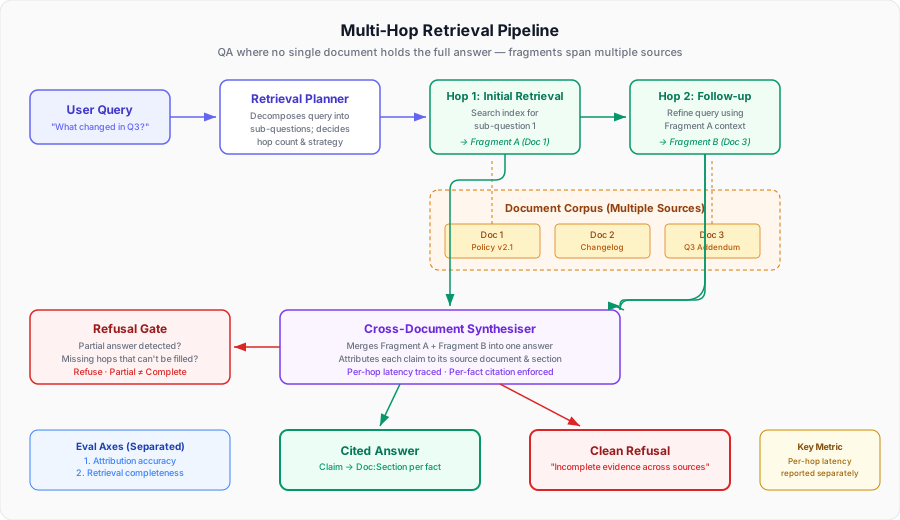
Build a QA system where answering a question requires combining fragments from multiple documents. No single document contains the complete answer, so retrieval must find pieces across sources and the system must synthesise them into one response with per-fact attribution.
Every answer names the document and section each claim came from. When the available fragments do not cover the question fully, the system refuses rather than presenting a partial answer as complete.
Core Challenge
Similarity search finds the first fragment but not the next.
The connection between fragments is logical rather than textual, so a single retrieval pass returns the obvious match and misses the rest. Retrieval needs a planning step after each hop to decide whether more evidence exists and where to look for it. Refusal is harder here than in single-document QA because the system must distinguish a partial answer from no answer, and a partial answer stated as complete is worse than a clean refusal.
Deliverables
- The systeman end-to-end multi-hop retrieval pipeline with per-fact citation, cross-document synthesis, and a refusal gate that catches partial answers.
- The test setscores attribution accuracy and retrieval completeness as two separate axes, never blended into one number.
- The trade-off notecompares single-hop against multi-hop retrieval on accuracy, latency, and cost, with measured numbers for each.
Skills Tested
Stand Out
Write the eval set before the system. Include a question where single-hop retrieval returns a confident wrong answer and the multi-hop path gets it right. Make the hop chain visible in a retrieval trace so a reviewer can follow each step. Report per-hop latency so the cost of each additional retrieval round is explicit.
Elective Build
You choose one of the following capstone projects. It is one additional project, not a list to complete.
- Build a voice agent on open-source models. Choose between a cascaded pipeline with Whisper for transcription and a speech-to-speech model, justify the choice with measured latency, and deploy it.
- Build a full-stack AI search product. A React frontend, a backend and an AI layer that returns cited answers with streaming. Deploy the frontend to Vercel so a reviewer can use it from a link.
- Build search over audio and video. Return the timestamped moment that answers a question rather than the whole recording.
- Build an MCP server for a real system. Expose the system's operations as tools with least-privilege access and an audit trail, so any model client can call it safely.
- Build an agent with an approval gate. Hold destructive actions for a human, and include a test suite that tries to get an action through the gate without approval.
- Convert messy documents into typed records. Extract a strict schema from scanned or inconsistent documents, attach a confidence score to each field, and state which fields a human must check.
- Build an evaluation harness for an existing agent. Score correctness, refusal behaviour and reasoning quality, and show that the harness measures what it claims to.
Interview Questions
A wealth management firm's advisors say the AI summaries are 'sometimes wrong' but disagree on what 'wrong' means. Some care about factual numbers, others about tone, others about risk-profile alignment. Design an evaluation system and get three disagreeing stakeholders to sign off on one quality bar.
Hiring Manager's Keen Eye
- Splits "wrong" into distinct failure modes unprompted, not after being nudged.
- Proposes different eval strategies per mode (automated for numbers, human-eval for tone, classification for risk).
- Has a forcing function for stakeholder disagreement, such as inter-rater reliability, not "let's have a meeting."
- Sets per-dimension thresholds that pass independently. Averaging is a red flag.
Weak-hire Answer
- LLM-as-judge with a 1 to 5 scale, averages the three dimensions into one score.
- "Have a meeting and get everyone aligned" is the entire stakeholder strategy.
- Suggests confidence scores and thumbs-up/down feedback, no labeled corpus.
- Treats tone and risk alignment the same way as factual accuracy.
Strong-hire Answer
- Decomposes into three failure modes immediately, with a different eval strategy per mode.
- Computes inter-rater agreement among the advisors first and uses their own disagreement rate as a negotiation lever.
- Per-dimension thresholds that must each pass independently, never averaged.
- Names the compliance risk on risk-profile misalignment explicitly.
- Proposes a "rate 10 borderline summaries" exercise to surface stakeholders' actual priorities.
I'm the COO. Your AI assistant told my regional manager we had 14,000 units of SKU-4419 in Cleveland when the real count was 1,400. Off by 10x. He nearly committed to a deal we couldn't fulfill. Why did this happen and what are you going to do about it?
Hiring Manager's Keen Eye
- Asks diagnostic questions before offering a theory.
- Localizes the failure to a specific layer (retrieval, generation, source data) instead of saying "AI hallucinates."
- Offers a specific deliverable on a specific day, not vague reassurance.
- Owns the system instead of distancing from it.
- Addresses the trust question (should I pull the plug) alongside the technical one.
Weak-hire Answer
- Opens with "the AI hallucinated" before asking a single question.
- Suggests adding a disclaimer to all AI responses.
- Hand-waves confidence scores and guardrails, no specifics.
- Closes by managing expectations ("no AI is 100% accurate") instead of owning the fix.
Strong-hire Answer
- Asks pointed diagnostic questions first. Was the source data correct? Was it a lookup or a calculation? Can they pull the exact thread?
- Localizes to two concrete hypotheses (retrieval error vs. generation error) and says they need logs to tell which.
- Commits to a named deliverable on a named day ("one-page finding by Friday").
- Proposes an interim safety net (surface the raw source record alongside the AI answer) scoped to the investigation period.
- Owns the system. "A 10x error on a simple lookup is exactly what my test suite should catch."
Three weeks into production, a user asked your AI assistant 'What discount did Acme Corp get on their last renewal?' and got real numbers. Another customer's actual contract pricing. Walk me through the next 48 hours. Who you call, what you shut down, how you scope the blast radius, and what has to be true before you turn it back on.
Hiring Manager's Keen Eye
- Contains first, debugs second. The feature goes down before root-cause starts.
- Thinks in blast radius. "How many other queries leaked that I don't know about?"
- Identifies the correct failure layer: access control in retrieval, not a model or prompt problem.
- Knows who to notify and in what order (engineering, affected customer, legal).
- States concrete, testable reactivation criteria, not "once we've fixed it."
Weak-hire Answer
- Starts with "reproduce to confirm" instead of containment. The system stays live while they investigate.
- Never mentions notifying the exposed customer (Acme) or legal.
- Proposes a system-prompt instruction ("don't reveal other customers' pricing") as the fix.
- Turn-back-on criteria is "once the fix works on test queries." No blast-radius audit, no customer notification gate.
Strong-hire Answer
- Disables the feature immediately, investigates after.
- Audits retrieval logs for cross-tenant data leaks across the full deployment window, not just the one known case.
- Notifies Acme (the exposed party) and loops in legal for reportable-incident determination.
- Names the correct failure layer. The model answered correctly. The retrieval path should not have returned that data.
- Four concrete reactivation criteria: tenant filter at query level, cross-tenant test suite on every deploy, blast-radius audit complete, affected customers notified and not blocking.
I'm the VP of Operations at a regional hospital network. Your scheduling assistant works well, and I want it to start telling patients which of their appointments they can safely skip, based on their records. My team needs this before our contract renewal next month. Make it happen.
What the hiring manager looks for
- Identifies that the request moves the system from scheduling into clinical advice, which changes the risk and the regulation that applies.
- Asks what problem the VP is trying to solve before refusing.
- Offers an alternative that solves the underlying problem within the boundary.
- Keeps the renewal conversation open without promising the original request.
Weak-hire answer
- Agrees to build it with a disclaimer added to every response.
- Refuses with "that's against policy" and offers nothing else.
- Treats it as a prompt-engineering task.
Strong-hire answer
- Asks what is driving the request: missed appointments, clinic capacity, or staff time spent on rescheduling.
- States plainly that deciding which appointments a patient can skip is a clinical decision, and that the assistant will not make it.
- Proposes an alternative inside the boundary: flag low-attendance patterns for clinical staff to review, or let patients request a reschedule that a clinician approves.
- Names who else must be involved (clinical leadership and compliance) and commits to a written proposal by a named date before the renewal.
AI Tools & Skills
Who This Course Is For
This is not an entry-level course. The FDE role sits on top of solid software engineering, adds applied AI, and is defined by customer-facing delivery. The course fits five backgrounds, and each one starts with a different gap to close.
- Software engineers already build and ship production services. Their gap is applied AI and the customer-facing half of the job.
- Machine learning engineers already understand models. Their gap is shipping: the frontend, caching, deployment and the customer conversation.
- Data engineers already move and clean data at scale. Their gap is LLM systems and customer delivery.
- Solutions architects and solutions engineers already work with customers. Their gap is building and deploying the system themselves.
- Engineering managers and technical leads already scope, plan and manage stakeholders. Their gap is becoming hands-on with agentic AI again.
Prerequisites
Four requirements. You should be comfortable writing Python and using Git and GitHub. You should have deployed at least one service in a Docker container. You should be able to write SQL and call a REST API. You need a subscription to an AI coding assistant such as Claude Code, Codex or Cursor.
Prior work with LLMs is not required. Frontend experience helps but is not required, and the course teaches enough React to put a demo interface in front of a customer.